

Snacks are a leading cause of damage to teeth in young children. It is important for parents to understand that the way kids snack may be doing as much damage as what they snack on.
Once parents know how and why snacks damage teeth, they can help their children develop teeth friendly snacking habits.
Often, parents are confused when their children have cavities.
“He doesn’t eat a lot of candy!” “She doesn’t drink any soda, only water and juice.” These are comments I hear from parents when I diagnose tooth decay.
In my experience as a dentist and as a mother, I see that unhealthy snacking is a major cause of dental decay. Fortunately, we can fix this while still allowing snacks.
Read this blog post to learn about healthy snacking for your family. Or click below to listen to Dr. Robinson’s 2 minute summary on WRHI radio.
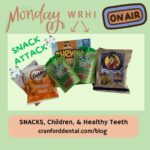
Candy, Sweets, and Sodas aren’t the only Snacks that cause Cavities
Oftentimes the most convenient snacks are crackers like Goldfish, chips, cookies, or fruit snacks. These are all high in carbohydrates that bacteria in the mouth love to feed off of.
Have you ever noticed that after a bag of Goldfish the grooves of your kids teeth appear orange? Sticky carbs from crackers stay on the teeth for hours and are a perfect snack for bacteria to cause cavities.
Do you think granola bars are a tooth-healthy alternative to candy bars? Think again! Many granola bars have added sugar. And they often have dried fruits and honey that cause the granola bar to stick to the teeth.
I am not suggesting that your children never eat crackers, chips, or granola bars. Realistically, that may be impossible.
Rather, I am offering healthy snacking practices that should be habits for you and your children no matter what snack you choose.
Here are tips on children and snacking:
Beware of Fruit Chewies and Vitamin Gummies
Even the “natural” fruit snacks or vitamin gummies can be unhealthy for teeth. They are very sticky and hard to remove from the tooth’s grooves even with a toothbrush. I recommend limiting chewy fruit snacks for special occasions only.
If your doctor prescribes vitamins for your child, please make sure they are sugar free. And give your child the vitamin before brushing instead of right before bedtime.
Encourage Crunchy Snacks
You don’t have to deprive your child of all snacks. In fact, crunchy foods like apples and carrots actually help clean the surfaces of the teeth.
An apple a day may actually keep the dentist away!
Fresh fruits and vegetables are much less sticky than dried fruits like raisins. Cheeses, nuts, and meats are other good tooth-healthy options.
If your child wants to eat crackers as a snack, pair them with something crunchy like celery to help keep the teeth cleansed.
Some of the tooth-healthy snack combinations that my kids love are:
- apples and whipped cream cheese
- carrots and hummus
- celery and peanut butter
- cheese cubes and grapes
- broccoli and ranch
These snacks are good for the teeth, but also help keep kids full so they aren’t begging for more snacks 30 minutes later.

Encourage crunchy and low sugar foods. Water is the best beverage for snack time. And lower sugar juices or flavored water are safer than fruit juices.
Avoid Constant Snacking
It seems we are living in a culture of constant snacking. Honestly, my kids and their friends are used to having snacks readily available throughout the day.
Truthfully, the healthiest way to snack is to do so at set times instead of constant munching throughout the day.
This allows the saliva time to cleanse the teeth. If you are constantly snacking, the pH in your mouth changes because saliva does have time to buffer the acid. An acidic environment is what most bacteria that cause decay thrive on.
Consider dropping the snack time if your child can stay satisfied from breakfast, lunch, and dinner. But if he needs a snack, encourage your child to finish eating it in a short window of time, such as 15 minutes.
This is better than the child walking around with a baggie or cup of Cheerios or Goldfish all day.
Brushing teeth after every meal and snack is ideal, but I understand that is not realistic since most children are in school or daycare.
Do not give Children Juice
Unless otherwise recommended by your pediatrician for digestive or dietary issues, your child does not need to drink juice. The American Academy of Pediatrics recommends that children drink only water between meals, and that juice consumption (if at all) in children ages 1 – 6 is limited to 4 – 6 ounces a day.
That’s not very much juice! Truthfully, children will be more satisfied with water alone.
A 2 year old child who carries a sippy cup of juice around all day is very likely to develop cavities. This is the reason the AAP updated their recommendation to limit juice.
Remind your family members that sweet drinks do not quench thirst. Rather they make you feel even thirstier.
For Healthy Teeth: Water, Water, Water
I say it to kids many times a day: “Did you know water helps keep your teeth strong?” Besides the benefits it has for overall health, water is very good for teeth.
During meals and snacks, water helps keep the mouth hydrated, which keeps food from sticking to teeth. Also, tap water is an excellent source of fluoride, which strengthens teeth and prevents decay.
Water is the best beverage to drink during most meals and snacks. Thus, reserve sweet tea, juice, and soda for special occasions.
Make sure your child is staying hydrated by drinking water throughout the day. Better yet, encourage her to make water a habit and to keep the water bottle close by.
Most camps, daycares, and schools ask you to send a water bottle with your child. Water should be the only thing in the bottle. If children sip on juice, Gatorade, KoolAid, or soda throughout the day, they will likely develop cavities.
Teach Healthy Habits
Encourage your kids to try healthy snacks by involving them in selecting and preparing food. Liddy loves picking apples so that she can eat them for a healthy snack.
Some of the recommendations I made may be new information for you. It can be hard to break bad snacking habits. It can also be hard to tell your child “no” when he or she is begging for unhealthy snacks and drinks.
The longer you practice healthy habits with your child, the easier it will become. The whining will decrease once the child realizes that you will not cave to it.
Keep in mind that changing your child’s snacking and drinking is for the best. It is much better for the child to prevent dental decay than it is to have to deal with it at the dentist.
What works in your family?
Do you have any suggestions for healthy snacks your family loves? Any creative ideas to prepare and encourage healthy choices?
Please share your ideas in the comments. Or talk let me know the next time you visit our office.
Dental Health for Children in Rock Hill, SC
At Cranford Dental, we love working with parents and children to establish healthy habits that will last a lifetime.
Dr. Elizabeth Cranford Robinson has years of experience helping children with good dental habits at Cranford Dental. Better yet, she practices with her three children at home in Rock Hill.
Eating foods that are healthy for your teeth will keep them strong and help avoid dental problems in the future.
Contact our office in Rock Hill, SC if you would like for our dentists and hygienists to work with your family members on dental habits for good teeth. Your child may like to start a healthy snacking plan and thus begin lifelong healthy snacking.
We love to welcome new patients to Cranford Dental. And we enjoy working with family members of all ages on maintaining healthy teeth.
Leave a Reply