
How can I know that Dental Implants are safe and correctly placed in my mouth?
Here I explain how dentists use technology to assure proper implant placement. Understanding this will give you confidence in your dental implant.
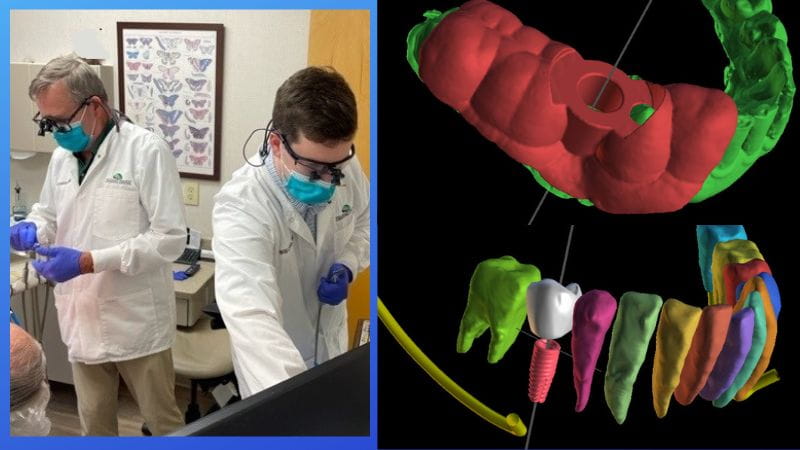
Technology keeps refining the dental implant process, with more predictable outcomes. At Cranford Dental, our dentists use advanced equipment and computer programs to design and place implants that are safe and accurately placed.
In this post, I will provide examples from a case we are working on now at Cranford Dental.
Initial Appointment
Make a consult appointment if you want to discuss dental implants. Or bring it up at your next cleaning. Our dentists will make you comfortable with implants and address your concerns.
Next, we will walk you through the process, including the time it will take and the cost. You will know exactly what is involved in getting a safe and accurate implant.
Then, using advanced technology, we will start gathering the information necessary to make sure your implant is a success.
Here is the technology we will use at Cranford Dental to ensure a successful dental implant for you:
CBCT X-Ray
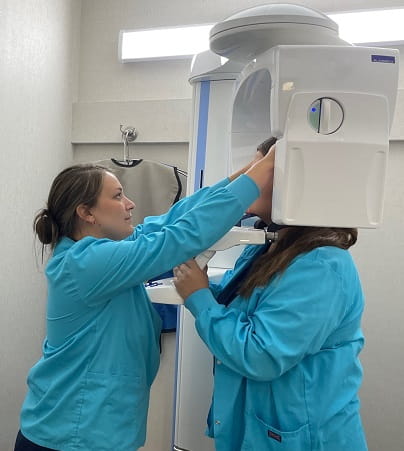

At your initial appointment, we use a CBCT X-Ray to take detailed images of your mouth.
CBCT stands for Cone Beam Computed Tomography, which is just a fancy way of saying a 3D x-ray. It takes a bunch of pictures of your mouth and layers them on top of each other. This gives us a 3 dimensional picture of your bones, teeth, sinuses, and nerves.
Important to know, the CBCT is designed and regulated to guarantee safety. For example, a sliding door covers the machine. Also, we passed a series of tests when we installed the CBCT, followed by monthly and yearly checks and evaluations.
The CBCT pictures are invaluable as we evaluate the future placement of your implant. Also, the pictures confirm that you have sufficient bone to hold an implant.
Digital Impression
Next we will take a 3D scan of your existing teeth and gums using our CEREC Primescan.
Cranford Dental has been taking 3D scans since 2002. Now, our PrimeScan gives very accurate models with no messy impression material. Due to constant improvements in technology, the scan now takes only minutes.
Once we have a complete scan and then answer your questions, we develop a plan for your implant.
Implant Case Work Up
After your consultation appointment, we begin planning your implant surgery and the crown that will go on top of the implant.
Interpreting the CBCT
First, we need to take a deep look at your x-ray.
How much bone is present? Are we close to any nerves or blood vessels? How strong is the bone? For safe and secure dental implants, the implant must go inside the bone and away from nerves and blood vessels.
Next we use computer software to place a simulated implant in the edentulous space. With the gathered information, we place the implant in the perfect location, accounting for bone width and height, bone quality, and proximity to nearby teeth, nerves, and arteries.
Planning the Crown
We start planning the crown by placing the 3D scan (from your initial appointment) into our design software. Here the simulated implant is placed in the bone.
But now we need to worry about the crown that people will see and you will eat with.
We place a simulated tooth in right tooth spot and then evaluate the fit and look of the implant in the mouth.
Combining the Images
Finally, we import the 3D xray into the design software and combine it with the 3D scan. This allows us to see how closely the planned implant and the planned crown line up.
We make small adjustments to the placement of both the implant and the crown. We need to make sure the implant and crown are lined up so that implant placement and crown fabrication are as straight forward as possible.
Now, the plan is in place, and we are ready to move forward
Make Implant Surgical Guide
With all of this information combined we are ready to design your surgical guide.
What is a Surgical Guide?
A surgical guide is a hard plastic appliance that fits precisely over the teeth adjacent to the implant site.
The guide directs the dentist to place the implant in the exact best position. This allows us to put the implant in the most secure and strongest position. The location, angle, and depth are perfectly matched to what we planned for this patient.
Thus, on the day of your surgery we are eliminating any areas of inaccuracy.
Not every implant will need a surgical guide. But when it is necessary, a surgical guide makes the process easier and more predictable.
Designing the Guide
Now the necessary information for the guide is already in our system. At this point, the dentist simply outlines the shape I want the guide to take. This shape depends on factors such as adjacent teeth and surgical site bone height.
The red overlay in this photo is the guide we used in a recent implant. As designed, it fit exactly over the teeth adjacent to the implant site.
Making the Guide
The guide is now in a format that can be printed on our 3D printer. Once I print the guide, it is ready for our specific brand of implants and your implant placement will be ready to begin.
At this time we also print a model of your existing teeth. Now we can check the fit of the surgical guide and run through the procedure before we next see you.
Implant Placement, Restoration and Beyond
With the surgical guide, your implant surgery will be easier than you can imagine. The dentist will be able to place the implant in the perfect location. Later, the perfect placement ensures that your crown will be simple to make.
Here you can see how the implant in our case is safely placed exactly as designed in the planning process.
In a later blog post, I will go through the process of placing the implant and putting the crown on top of it.
Dental Implants in Rock Hill at Cranford Dental
Dr. Will Cranford’s 2 minute interview on Implant Technology on WRHI Radio in Rock Hill, SC.
A lot goes into the dental implant process at Cranford Dental. Thankfully, we have the advanced equipment and training to give you assurance getting a dental implant will be safe and accurately placed.
The technology that makes this possible in a dental office is amazing. And for the implant used in this post, I enjoyed mixing the years of experience of the “older dentist” with the recent training in technology of the “younger dentist.”
We were both very pleased with the placement of this implant.
Contact Cranford Dental if you are interested in learning how a dental implant will benefit you. We would love to show you some of the cool technology that makes for safe and stable dental implants.
Leave a Reply